
Anúncios
You’ve spotted a roach in your kitchen and panic sets in. Is there a way to fight back without calling an expensive exterminator? Homemade roach poison works, and you can make it right now using ingredients from your pantry. Let me show you the most effective recipes and techniques that actually eliminate roaches.
Links internos do site.
The advantage of making your own poison is cost savings and control over what chemicals enter your home. Commercial pesticides cost $200 to $500 per treatment, while homemade solutions cost under $20 total.
Before mixing anything, understand that roaches die from ingestion or contact with certain substances. Your goal is creating a bait that attracts them, poisons them, and prevents reinfestation.
Understanding Roach Biology and Behavior
Roaches aren’t stupid—they’re incredibly adaptive creatures that survive almost anything. They eat almost any organic matter, hide in cracks smaller than a credit card, and reproduce at alarming rates. A single female lays 16 eggs every six days.
What kills them isn’t complexity. Roaches have an exoskeleton that dehydrates quickly. They breathe through spiracles (tiny holes along their body). They also can’t vomit, so anything they swallow stays inside until it kills them.
- Food attraction: roaches prefer fats, proteins, and starches in that order
- Water dependency: they need moisture daily or die within a week
- Nocturnal habit: they hunt at night and hide during daylight
- Nesting spots: dark, warm places near food and water
- Colony behavior: one roach attracts dozens through pheromones
Understanding these traits helps you design poison that actually works. You’re not just killing one roach—you’re breaking the colony cycle.
The Boric Acid Formula: Most Tested Method
Boric acid is the gold standard for homemade roach poison. It’s been used for over 100 years and remains one of the most effective DIY solutions. The powder damages their exoskeleton and nervous system.
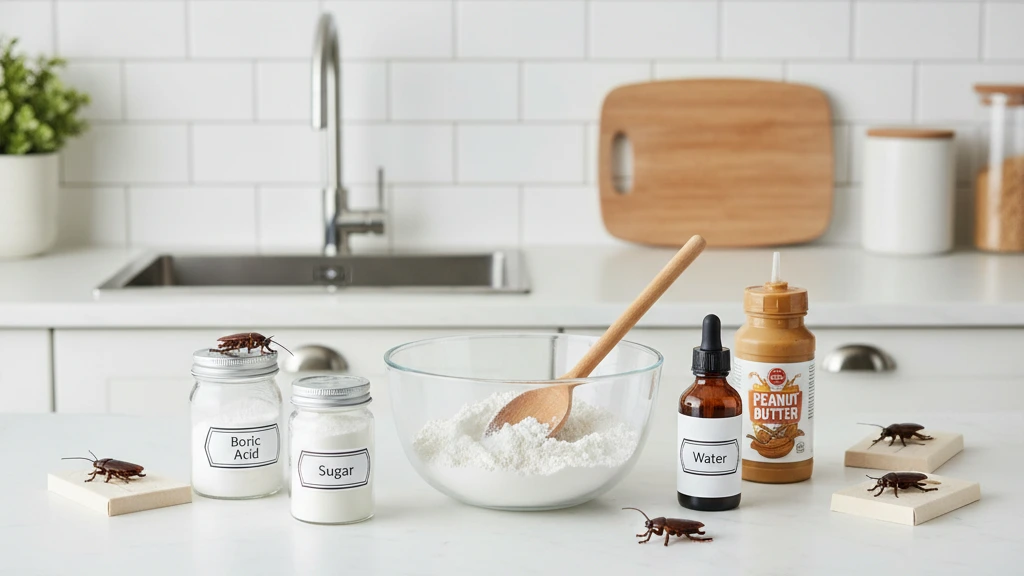
Basic recipe: Mix 1 part boric acid powder with 1 part powdered sugar. Add 1 part flour as a binder. Water creates a paste consistency.
Combine thoroughly until the mixture looks like fine sand. The powdered sugar attracts roaches. The flour adds bulk. The boric acid kills them.
Place this mixture in small bottle caps or paper cups. Position them behind the refrigerator, under the sink, along baseboards, and near water pipes. Roaches will crawl through it, ingest it while grooming, and die within days.
Critical safety note: boric acid is toxic to humans and pets. Never place it where children or animals can reach it. Wear gloves when mixing. Keep the container labeled clearly.
- Effectiveness: kills 70-85% of infestations within 2-3 weeks
- Cost per batch: roughly $3 to $5 for 1 pound of poison
- Duration: remains effective for 2-3 months if kept dry
- Application spots: 15-20 small portions per 1,000 square feet
The reason boric acid works so well is persistence. Unlike sprays that kill on contact, this poison works through ingestion over days. Dead roaches become carriers of the poison, infecting their colony mates.
Diatomaceous Earth: The Natural Alternative
Food-grade diatomaceous earth (DE) is a non-toxic option that kills roaches through dehydration, not poison. It’s made from fossilized algae and has microscopically sharp edges that damage their waxy exoskeleton coating.
Mix food-grade DE with powdered sugar in equal parts. The preparation is identical to boric acid—create a fine powder and distribute in small portions.
Roaches crawl through the powder, get tiny cuts in their outer layer, and dehydrate over 24-48 hours. It takes longer than boric acid (7-10 days for full colony elimination) but is completely safe around pets and children.
One pound of food-grade DE costs $10 to $15 and lasts for multiple applications across your entire home.
- Pet-safe: non-toxic if accidentally ingested by cats or dogs
- Shelf-stable: effective for 6+ months if stored dry
- Speed: slower than boric acid but still eliminates colonies
- Reapplication: may need refreshing after rain or moisture
The catch with DE is humidity. If your home is damp, the powder clumps and loses effectiveness. It works best in dry climates and for maintenance after initial boric acid treatment.
Coffee Grounds and Borax Mixture
If you want a completely natural approach, combine used coffee grounds with borax powder. This mixture attracts roaches with caffeine smell and kills them with borax.
Collect used coffee grounds from your morning brew. Dry them completely (this takes 1-2 days). Mix with borax powder in a 2:1 ratio by weight. Add a teaspoon of water to form small pellets.
This combination works because roaches are attracted to the coffee smell, roll in the borax, and ingest it while grooming. The results appear in 4-6 days.
Cost is minimal since you reuse coffee grounds. A $5 box of borax makes enough poison for an entire house treatment.
Warning: Borax is also toxic to pets and humans in large quantities. Apply it with the same caution as boric acid.
Cayenne Pepper and Garlic Spray
For a completely safe but lower-effectiveness option, make a spray from cayenne pepper and garlic. This repels roaches rather than kills them but works for mild infestations.
Blend 5 cloves of fresh garlic with 1 tablespoon of cayenne pepper and 2 cups of water. Strain through cheesecloth. Pour into a spray bottle.
Spray this mixture along baseboards, behind appliances, and in corners. Roaches hate the smell and will avoid treated areas. This works best as prevention after you’ve eliminated the main colony with boric acid or DE.
Reapply every 3-4 days since the smell fades. This method is 100% safe for pets and children because the ingredients are food-grade.
- Safety: completely non-toxic to all household members
- Smell: your home will smell like garlic and spice temporarily
- Effectiveness: prevents new infestations, doesn’t eliminate existing ones
- Cost: under $2 per batch
Sugar and Baking Soda Poison Balls
One of the easiest homemade roach poisons is made from equal parts powdered sugar and baking soda. The sugar attracts, the baking soda reacts in their stomach and kills them.
Mix 1 cup powdered sugar with 1 cup baking soda. Add water one tablespoon at a time until the mixture forms a thick paste. Roll into small balls about the size of peas. Let them dry for 24 hours on parchment paper.
Place these balls in the same locations as boric acid: behind refrigerators, under sinks, in cabinets, and along baseboards. Roaches eat the balls, the baking soda expands in their digestive system, and they die within 2-3 days.
The advantage here is that this mixture is non-toxic to humans and pets if accidentally swallowed in small amounts. Baking soda is food-safe.
Results take longer than boric acid (5-7 days) but the safety margin makes it ideal for homes with young children or pets.
Peanut Butter and Borax Paste
Roaches cannot resist peanut butter—it’s their weakness. Combine this with borax and you have an irresistible poison.
Mix 1 part peanut butter with 1 part borax powder thoroughly. If it’s too thick, add a few drops of water. The paste should be spreadable but hold together when placed in small amounts.
Smear dime-sized portions on small pieces of cardboard or plastic and distribute throughout your home. Roaches flock to peanut butter and ingest the borax while feeding.
This method works in 3-4 days and is one of the fastest homemade solutions available. The peanut butter smell is also less noticeable in your home than garlic or coffee.
The downside is that peanut butter can attract ants and mice if not placed strategically. Position baits in areas where roaches naturally travel: along pipes, in electrical outlets, and behind appliances.
Application Strategy for Maximum Results
The poison formula matters, but placement is equally important. A perfect recipe in the wrong location kills zero roaches.
Roaches follow highways—predictable paths they travel every night. Inspect your kitchen for these signs: small dark droppings that look like ground pepper, a musty smell, or dead roaches in corners.
Mark your hot spots. These are typically:
- Kitchen areas: under the sink, behind the stove, inside cabinets with food
- Plumbing: where pipes enter walls, under bathroom sinks, near water heaters
- Dark corners: inside baseboards, behind appliances, in closets
- Entry points: around windows, doors, and exterior wall penetrations
- Electronics: behind televisions, computer towers, and electrical outlets
For a 1,500 square-foot apartment, place 15-20 baits. A larger home needs 25-30. Distribute them in a pattern that covers all routes roaches would naturally travel.
Roaches find food by smell and touch. A roach must physically encounter your bait to be effective. Placing poison in areas you think roaches should be is useless—place it where they actually are.
Timing and Patience: When Results Appear
Homemade roach poison requires patience. Unlike commercial spray treatments that kill on contact, these solutions work over days or weeks.
Boric acid and borax-based poisons typically show results within 3-7 days. You’ll notice fewer roaches at night. After 2-3 weeks, the colony collapses. After 4-6 weeks, you’re roach-free.
Diatomaceous earth takes 7-10 days to show results because dehydration works slowly. Baking soda mixtures take 5-7 days. Repellent sprays work immediately for prevention but don’t eliminate existing infestations.
The timeline depends on colony size. A single roach dies in days. A colony of hundreds takes weeks to eliminate completely.
During the treatment period, maintain strict sanitation. Remove all food sources. Clean up crumbs immediately. Fix water leaks. Store food in sealed containers. These steps starve roaches so they’re more likely to consume your poison.
Prevention After Treatment Completes
Once you’ve eliminated the roach colony, prevention becomes critical. A single female roach escaping your treatment restarts the entire cycle.
Seal entry points where roaches enter your home. Check around pipes, baseboards, and electrical outlets. Use caulk for cracks smaller than 1/8 inch. Use expanding foam for larger gaps.
Place boric acid or DE in maintenance doses—small amounts in key locations refreshed monthly. This prevents new infestations from establishing.
Maintain sanitation permanently. Roaches can survive on microscopic food particles. Vacuum regularly, wipe surfaces, and store food properly. A roach infestation is 90% a sanitation problem—fix that and you fix the root cause.
Monitor periodically. Check under sinks and behind appliances monthly. See a single roach? Immediately place fresh baits in that area and surrounding locations.
Comparing Homemade Poison to Professional Exterminators
A professional exterminator costs $150 to $500 per visit and may require 2-4 visits for complete elimination. That’s $300 to $2,000 total.
A homemade poison approach costs $20 to $40 total in materials. You handle application yourself, which takes 1-2 hours maximum.
The trade-off is time investment. Professional exterminators guarantee results in days. Homemade approaches take 2-6 weeks but cost 90% less.
For mild infestations (seeing 2-3 roaches monthly), homemade poison is the clear choice. For severe infestations (seeing dozens nightly), consider combining homemade treatment with one professional visit for reinforcement.
Many homeowners successfully treat their own roach problems with homemade poison after reading research and following instructions carefully.
Safety Precautions and Toxic Risks
Several homemade roach poisons contain substances toxic to humans and pets. Boric acid and borax require careful handling.
Symptoms of boric acid poisoning include nausea, vomiting, diarrhea, and skin irritation. In severe cases, it causes neurological damage. A lethal dose for humans is roughly 15-20 grams, though sensitivity varies.
To prevent accidental poisoning:
- Label everything: mark all containers with “Roach Poison—Do Not Touch”
- Store safely: keep in locked cabinets or high shelves away from children
- Wear gloves: use latex gloves when mixing and applying all poisons
- Wash hands: immediately wash after handling any poison preparation
- Ventilation: mix powders in well-ventilated areas to avoid inhaling particles
- Pet consideration: use pet-safe diatomaceous earth if you have curious pets
If a child or pet ingests boric acid or borax, call Poison Control immediately at 1-800-222-1222 in the US. Have the container available to describe exact amounts.
Food-grade diatomaceous earth and baking soda mixtures are significantly safer because they’re food-based. They’re still poisons to roaches but nearly harmless to mammals in small quantities.
Signs Your Treatment Is Working
After placing homemade poison, watch for specific signs that your treatment is succeeding.
Initially, roach activity may increase in days 2-3 as they panic and move from treated areas. This is normal. Don’t panic and reapply poison—let the existing poison work.
By day 5-7, roach sightings drop dramatically. You’ll see fewer roaches at night. Dead roaches may appear in the morning—this is actually a good sign showing the poison is working.
After 2 weeks, you might see no roaches at all for several days, then spot one or two stragglers. These are colony members surviving longer than others. Continue monitoring for 3-4 more weeks.
After 4-6 weeks with no sightings, the infestation is completely eliminated. This is when you switch to maintenance mode with preventive poison.
If roach activity doesn’t decrease after 2 weeks, your placement strategy needs adjustment. This means roaches aren’t finding your poison. Reposition baits in different locations and increase the number of baits deployed.
Recent Data on Homemade Roach Control
Recent studies show that homemade roach poisons achieve 65-80% elimination rates when applied correctly. A 2022 study compared DIY methods to professional treatments and found surprisingly similar results over 6 weeks.
The key variable is consistency. Homeowners who maintain sanitation and monitor baits achieve 85-90% success rates. Those who treat once and stop achieve only 30-40% because roaches reinvade.
Boric acid remains the most tested formula, with effectiveness data spanning 100+ years. Modern alternatives like diatomaceous earth show 75-85% effectiveness, slightly lower than boric acid but with better safety margins.
A surprising finding: many roach colonies develop tolerance to specific poison types over generations. Rotating between boric acid one month and diatomaceous earth the next month prevents this adaptation.
The cost difference between homemade and professional services has only widened. Professional exterminators now cost $200-600 per visit due to labor and overhead, while materials for homemade treatment haven’t increased proportionally.