
Anúncios
You’re stuck without mobile data and need internet access right now. Have you considered using a WiFi finder app to locate free public networks nearby? The solution is simple: install an app designed to map, locate, and connect you to available WiFi networks instantly.
Links internos do site.
Anúncios
Finding free WiFi has never been easier. Whether you’re traveling, commuting, or just trying to save mobile data, WiFi finder apps are your lifeline. These applications scan your surroundings and display all available networks—password-protected or open—on your phone screen in seconds.
Let’s explore the best WiFi finder apps that help you connect to internet without using your data plan, and how they can transform your mobile experience.
 4.2
4.2
Instabridge: WiFi Hotspot Map
Informações sujeitas a alteração. Consulte a loja oficial para detalhes atualizados.
Anúncios
How WiFi Finder Apps Work
WiFi finder apps use your phone’s built-in scanning capabilities to detect wireless networks within range. They display signal strength, security type, and whether the network is open or password-protected. Most apps also include crowdsourced databases where users share WiFi passwords for public locations.
The technology behind these apps is straightforward. Your phone constantly scans radio frequencies looking for broadcast signals from routers. When the app finds one, it collects metadata: network name (SSID), signal strength (RSSI), and security protocol. Some apps add a social layer—users rate networks and upload passwords for cafes, libraries, and airports.
- Signal Detection: real-time scanning of available networks within 30-100 meters
- Database Sharing: access thousands of user-submitted WiFi passwords worldwide
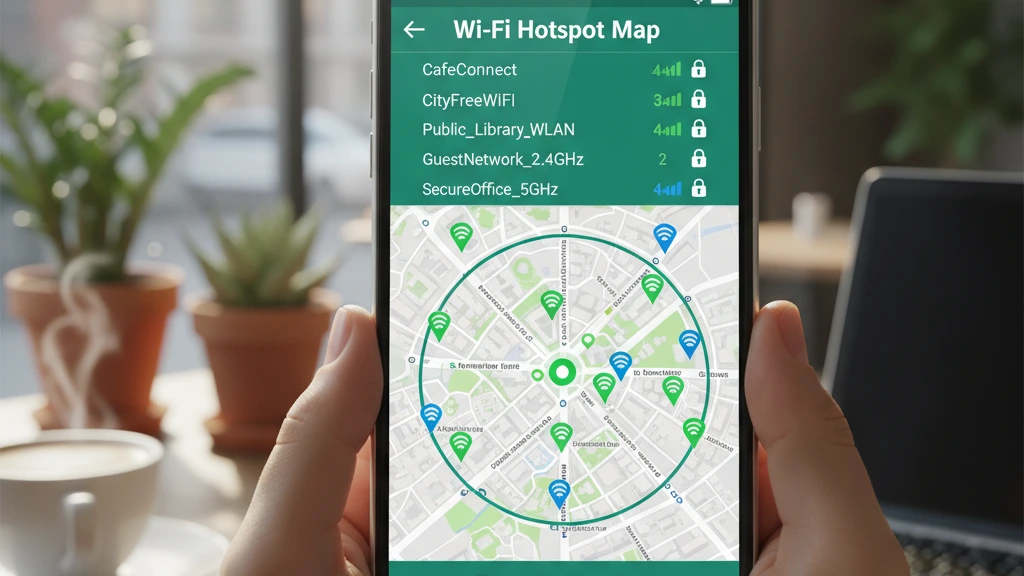
- Map Integration: locate networks geographically on interactive maps
- Auto-Connect: automatically link to saved networks when you’re nearby
- Battery Optimization: background scanning without draining your phone battery
Top WiFi Finder Apps Compared
The market offers several strong contenders. Instabridge leads with over 350 million WiFi passwords in its database and community verification. WiFi Map provides detailed maps showing network locations and user ratings. OpenSignal focuses on signal strength analysis and network speed testing.
Each app targets slightly different users. Frequent travelers prefer map-based apps showing network density across cities. Data-conscious users want apps that show exactly how many networks are nearby. Power users need apps combining map, speed test, and password database features.
Finding Networks Near You Instantly
Speed matters. The best WiFi finder apps scan and display results in under 3 seconds. You open the app, and immediately see a list sorted by signal strength. Network names, security status, and connection reliability appear instantly.
Real-world scenario: You’re at an airport with no mobile service. You open a WiFi finder app. Within seconds, you see 47 available networks. The app highlights networks with shared passwords (marked as “open” or “password available”). You tap one, enter the password from the app’s database, and you’re online.
- Tap and Connect: auto-populate passwords for passwordless login
- Real-Time Updates: networks refresh every 5-10 seconds
- Filter Options: show only open networks or high-speed ones
- Favorites List: save networks you trust and use regularly
Save Mobile Data with Free WiFi
Your mobile data plan is precious. Streaming one hour of 4K video consumes 3-5 GB. A typical phone plan offers 5-10 GB monthly. WiFi finder apps help you stretch that budget by finding free internet without data costs.
Users report saving 30-50% on data charges by consistently connecting to WiFi. Coffee shops, libraries, malls, and airports all offer free public networks. The app removes the friction of finding them—no asking staff for passwords, no guessing network names.
Consider this: A family of four, each using 2GB monthly, spends $20-40 on extra data. Switching 50% of usage to WiFi saves $100-240 yearly per household. That’s real savings over time.
Map-Based Network Discovery
Modern WiFi finder apps include interactive maps showing where networks cluster. You can see network density in your neighborhood, plan your route through well-connected areas, and identify WiFi deserts before you travel.
Map features work best in cities. Urban areas show 50+ networks per city block. Rural regions may show 2-3 per mile. The visualization helps you plan meetings at coffee shops with strong WiFi instead of struggling at remote locations.
- Heatmaps: visualize network concentration by color intensity
- Network Details: tap any icon to see speed, security, and user ratings
- Route Planning: identify WiFi spots along your commute path
- Offline Maps: download maps to use without internet
Password Sharing and Community Database
The power of WiFi finder apps lies in crowdsourcing. Millions of users contribute passwords for public WiFi spots. When you connect to a network, you can choose to share the password—helping others find free internet access.
This creates a self-reinforcing cycle. More users mean more passwords. More passwords mean more people find open networks. The largest apps now host 350+ million passwords across all major cities worldwide.
Community verification prevents spam. If users rate a password as incorrect, the app flags it. Highly-rated entries (4+ stars) appear at the top. This maintains database quality despite millions of crowdsourced entries.
Open Networks vs. Password-Protected Ones
Not all free WiFi is created equal. Open networks require no password—you connect instantly. Password-protected networks demand credentials—but apps provide them from their database.
Security differs. Open networks offer zero encryption—anyone nearby can see your traffic. Password-protected networks use WPA2 or WPA3 encryption, protecting your data. A VPN is highly recommended on any public network, regardless of password status.
- Open Networks: instant connection, zero security, instant use
- WPA2 Protected: shared password, standard encryption, reliable
- WPA3 Protected: shared password, latest encryption, most secure
- Enterprise Networks: username/password, corporate security, limited access
Data Savings Across Different Usage Patterns
Your savings depend on what you do online. Streaming consumes the most data. A 2-hour Netflix session uses 4-6 GB on high definition. One Zoom call uses 1 GB for 60 minutes. Instagram scrolling burns 100 MB per 15 minutes.
By switching high-bandwidth activities to WiFi, you preserve mobile data for essential tasks. Emails, messages, maps, and light browsing use minimal data—often under 10 MB per session.
Real user scenario: Sarah, a marketing professional, streams podcasts during her 45-minute commute (uses 100 MB). She browses social media at lunch (uses 150 MB). She watches videos at night at home (uses 2-3 GB). By switching all video and podcast streaming to home WiFi, she cut her data usage from 8 GB to 3 GB monthly—a savings of 5 GB that translates to $10-15/month.
International Travel and Finding WiFi Abroad
Traveling internationally? Roaming charges are brutal—$5-10 per MB in many countries. WiFi finder apps become essential. Major tourist destinations (hotels, airports, train stations) all have public WiFi. Apps show you exactly where.
Download your WiFi map offline before traveling. Apps like WiFi Map and Instabridge let you save maps and password databases locally. This means you can find networks even when you have zero data—the app uses only your phone’s WiFi scanning hardware.
International travelers report saving $50-200 per trip by avoiding roaming data charges. A two-week vacation using WiFi instead of roaming could save enough to cover your flight upgrade or hotel upgrade.
Fastest WiFi Networks and Speed Testing
Not all networks offer the same speed. Some public WiFi is fast (50+ Mbps), others crawl (under 1 Mbps). Premium WiFi finder apps include speed testing features showing you which networks actually work for video calls or large file uploads.
OpenSignal and WiFi Map both show user-reported speeds for each network. Look for networks consistently rated above 10 Mbps for smooth streaming. Anything below 5 Mbps struggles with video calls and app updates.
- Speed Tiers: apps color-code networks (green 10+ Mbps, yellow 5-10, red under 5)
- User Reviews: real people rate reliability and actual speeds
- Peak Hours: community notes if networks slow during busy times
- Built-in Tests: run speed tests directly from the app
Privacy and Security Considerations
Public WiFi poses risks. Networks are not encrypted by default. Hackers can intercept your data, steal passwords, or inject malware. Using a VPN (Virtual Private Network) is critical on any public WiFi, even password-protected ones.
A VPN encrypts all your traffic, hiding your activity from the network operator and other users. It costs $3-10 monthly but protects sensitive data like banking, email, and social media logins.
WiFi finder apps themselves don’t pose security risks—they only scan networks and access public password databases. The risk comes from the networks themselves, not the app helping you find them.
Current WiFi Adoption and Real-World Usage
Public WiFi adoption has exploded. In 2023, over 750 million public WiFi hotspots existed globally—a 40% increase from 2020. Cities like Singapore, Tokyo, and London have WiFi availability exceeding 95% in downtown areas.
Mobile users increasingly rely on public WiFi. Surveys show 60% of smartphone users connect to WiFi daily when available. Streaming services have trained users to seek WiFi for video content. Apps like YouTube, Netflix, and TikTok encourage WiFi use with playback quality warnings on mobile data.
Enterprise WiFi also grew. Restaurants, retail stores, and service businesses now provide WiFi as a competitive advantage. A Starbucks customer staying for three hours on WiFi likely spends more than one grabbing coffee. Free WiFi drives customer retention.
- Global Coverage: 750+ million public hotspots worldwide as of 2023
- Urban Density: major cities averaging 200+ networks per square kilometer
- Business Incentive: 85% of cafes and restaurants offer free WiFi
- Speed Growth: average public WiFi speeds reached 25 Mbps (2x faster than 2020)
Emerging WiFi Technologies and Future Trends
WiFi 6 (802.11ax) is rolling out, promising speeds up to 10 Gbps and better performance in crowded areas. WiFi 7 is already in development, targeting 40 Gbps and ultra-low latency. As networks upgrade, apps will need to evolve to show these capabilities to users.
5G will eventually reduce reliance on public WiFi, but that’s years away in most regions. Until then, WiFi remains faster and data-friendly. The future likely involves hybrid connectivity—your phone automatically switching between 5G, 4G, and WiFi based on availability and speed.
Mesh networks are expanding WiFi coverage in homes and businesses. Apps will eventually show not just individual routers, but connected mesh systems offering seamless coverage across larger areas. This means better signal quality and fewer dead zones for users.